The architecture of exclusivity
Why so many clubs live in borrowed palaces: Roman on Pall Mall, Florentine on Fifth Avenue, and one Victorian casualty in Hong Kong.
- By
- The Index
- Published
- Length
- 4 minute read
A club has a peculiar architectural problem. It must look important from the street, so that members feel they have arrived somewhere. It must also look closed, so that nobody else thinks of coming in. For two centuries the answer, again and again, has been the same: build a palace, and leave off the sign.
St James's Street: the private house
The oldest clubs did not set out to build monuments. They grew out of chocolate houses and taverns and moved into buildings that looked like the grand private houses around them. Boodle's has been at 28 St James's Street since 1782, in a house designed by John Crunden in 1775. Brooks's, across the road at number 60, is a Palladian building by Henry Holland, completed in 1778. White's acquired its present façade, by James Lockyer, in 1852.
These are domestic buildings, and that is their message. A club on St James's Street presents itself as a gentleman's house, which is precisely what it wished to be: a second home with better wine. Its one great architectural gesture is a window. White's bow window, with its single table, was for decades the most watched seat in London, occupied in turn by Beau Brummell, Lord Alvanley and the Duke of Wellington. The point of the window was to be seen from the street while remaining entirely out of reach.
Pall Mall: the palace
A generation later, the clubs on Pall Mall chose a grander language. In 1824 John Wilson Croker founded the Athenaeum for men of science, literature and the arts, and Decimus Burton gave it a Greek temple of learning. Completed in 1830, it carries a frieze copied from the Panathenaic procession of the Parthenon, executed by John Henning, and a statue of Pallas Athene by Edward Hodges Baily over the porch. It is less a house than a manifesto.
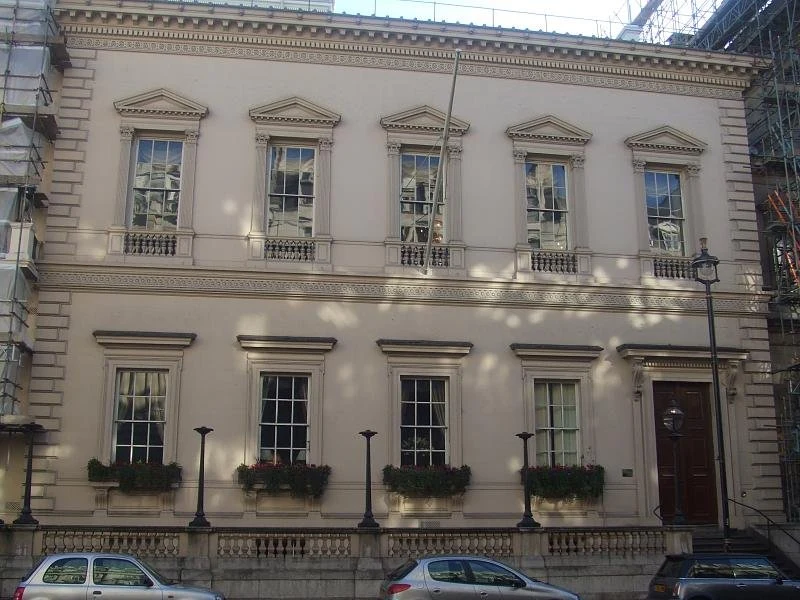
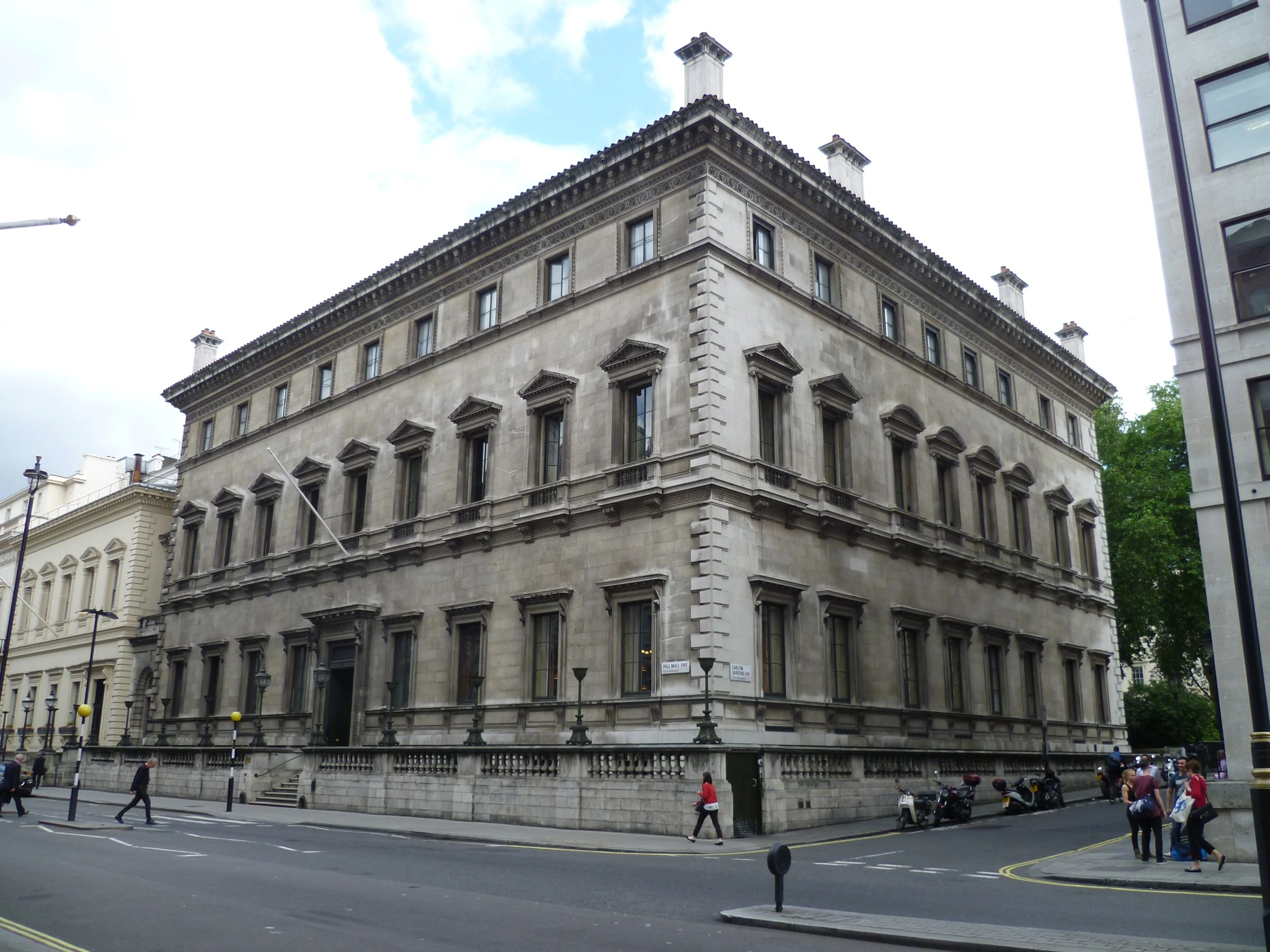
A few doors along, Charles Barry looked to Italy. His Travellers Club, register No. 027, completed in 1832, is a Renaissance palace said to be inspired by Raphael's Palazzo Pandolfini in Florence; its library carries a cast of the Bassae frieze. Barry then built the Reform Club, register No. 045 nearby, opened in 1841 and based on the Palazzo Farnese in Rome. Its Saloon is regarded as the finest room in any London club.
Build a palace, and leave off the sign.
The Italian palazzo suited a club perfectly. It was the house of a merchant prince: powerful, private, organised around an inner court, with a plain and forbidding face to the street. A Victorian member walking from his office to the Reform passed through the same arrangement as a Florentine banker returning home: public façade, guarded door, a world inside.
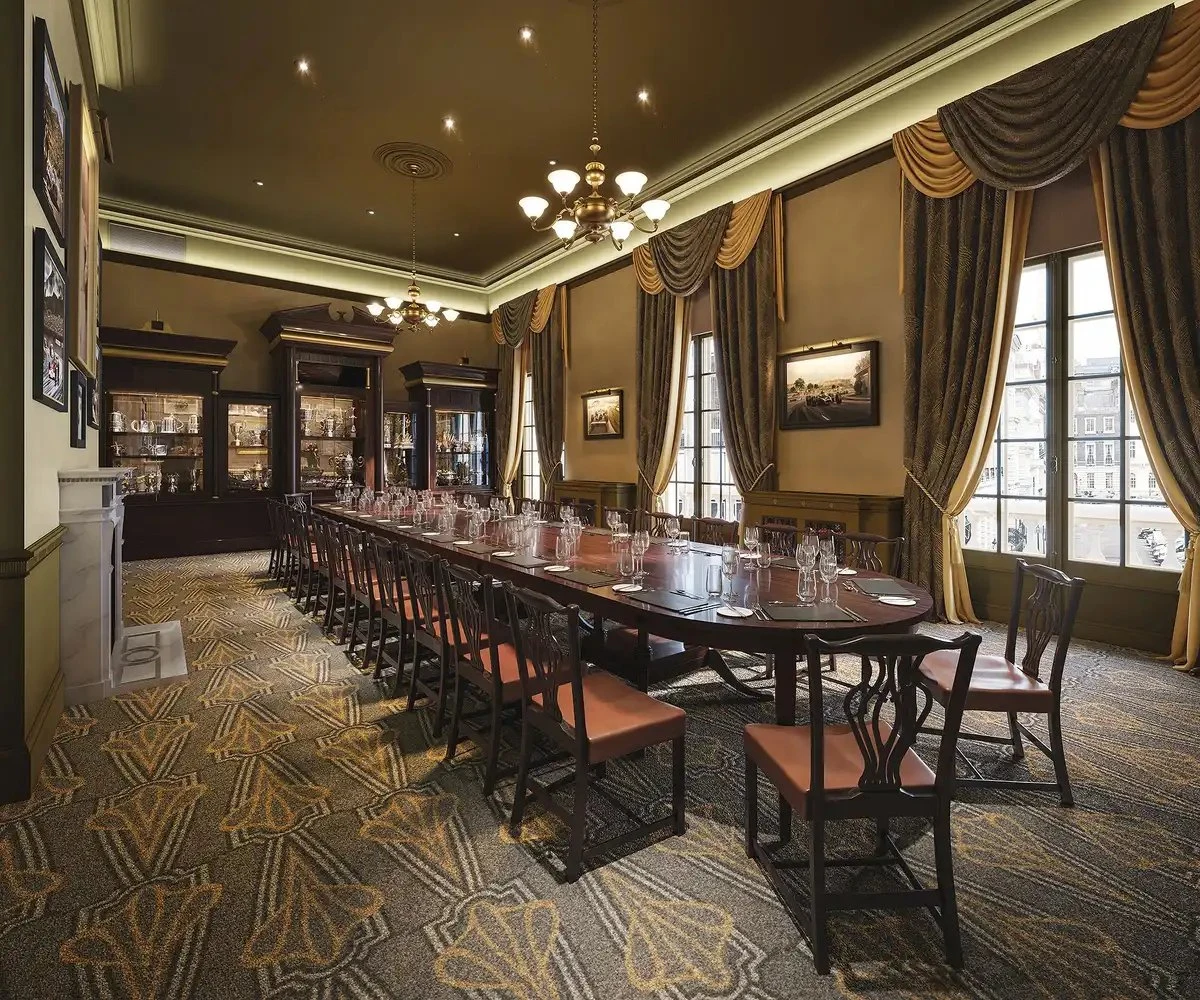
By 1911 the vocabulary had moved on to France. The Royal Automobile Club, register No. 264, designed by Mewès & Davis with E. Keynes Purchase on part of the old War Office site, was described by the Survey of London as "a polished essay in the late French Renaissance manner". Below it lies an Art Deco marble swimming pool. The palace had acquired plumbing.
Fifth Avenue: the palazzo crosses the Atlantic
New York took the idea and made it bigger. McKim, Mead & White built three of the city's great clubs in little more than a decade. The Century Association on West 43rd Street, built between 1889 and 1891, is a palazzo. Stanford White's Metropolitan Club at Fifth Avenue and 60th Street, opened in 1894, was built for J. P. Morgan's new club, and looks it. Charles McKim's University Club at Fifth and 54th followed in 1899.
The next generation of New York clubs went back to the domestic model. Delano & Aldrich gave the Knickerbocker a neo-Georgian house on East 62nd Street in 1915, the Colony Club its Park Avenue clubhouse a year later, and the Union Club its present building in 1933. After the Gilded Age palaces, these look almost shy. That too was the point.
Paris: the courtesan's house
The most extravagant clubhouse in the register was not built for a club at all. Between 1856 and 1866 the architect Pierre Manguin built a Renaissance-style mansion on the Champs-Élysées for Esther Lachmann, the courtesan known as La Païva. Its yellow onyx staircase is described as probably unique in the world. Since 1904 it has been the home of The Travellers, a gentlemen's club. The house that was built to be talked about now belongs to people who prefer not to be.
Hong Kong: the casualty
Not every club kept its palace. The Hong Kong Club moved in 1897 into a Victorian building on Jackson Road. In 1981, despite efforts to preserve it, the building was demolished. Its replacement, by Harry Seidler and Associates, is a twenty-five-storey tower; the club occupies eight floors and lets the rest as offices. It is a clear-eyed answer to the economics of land in Central, and a reminder that the borrowed palace was always a luxury.
What the buildings say
Seen together, the clubhouses make an argument about belonging. The street front is generous, even showy: columns, friezes, a goddess over the porch. The entrance is narrow. The rooms that matter are upstairs, or at the back, or both. Every one of these buildings performs the same trick, which is to make the city feel the club's presence without ever being invited to share it.
This essay replaces an earlier, unsourced piece published under the same title. The buildings are real, and the facts above are sourced; the members, as ever, are not available for comment.
Sources
- White's, Wikipedia
- Brooks's, Wikipedia
- Boodle's, Wikipedia
- Athenaeum Club, London, Wikipedia
- Travellers Club, Wikipedia
- Reform Club, Wikipedia
- Royal Automobile Club, Wikipedia
- Metropolitan Club (New York City), Wikipedia
- Century Association, Wikipedia
- University Club of New York, Wikipedia
- Knickerbocker Club, Wikipedia
- Union Club of the City of New York, Wikipedia
- Colony Club, Wikipedia
- Hôtel de la Païva, Wikipedia
- Hong Kong Club Building, Wikipedia
- How easy is it to join 5 Hong Kong private clubs that recall the city's colonial past?, South China Morning Post