Hong Kong and Singapore: the colonial clubs today
Built for merchants and officials of an empire that has gone, the old clubs of the two port cities have outlived their founding rules. Mostly.
- By
- The Index
- Published
- Length
- 4 minute read
- Filed from
- Central, Hong Kong, and the Padang, Singapore
The clubs of Hong Kong and Singapore were founded to do one thing, which was to give a small, homesick ruling class somewhere to be among its own. They were very good at it. They are now asked to do something else entirely, which is to be useful to the cities that replaced that class. Some have managed the change with grace. All of them have kept the furniture.
The Hong Kong Club
The Hong Kong Club opened on 26 May 1846, and is the oldest private club in the territory. It was set up by British merchants and civil servants to "create a greater community of feeling among these classes", a phrase that is honest about who the classes were. Its first clubhouse stood at the corner of Queen's Road and D'Aguilar Street. In 1897 it moved to a Victorian building on Jackson Road.
For most of its history, membership was in practice limited to Europeans. The rules began to ease only in the late 1970s, and by the early 1980s there were still only a few Chinese members. Women were kept out of parts of the club until the Sex Discrimination Ordinance, in force from 1996, obliged it to admit them.
The building went first. Despite efforts to preserve it, the Victorian clubhouse was demolished in 1981. Its replacement, designed by Harry Seidler and Associates of Sydney, is a tower at 1 Jackson Road, and the club occupies eight of its floors; the rest is let as offices. It is, in its way, the most Hong Kong answer imaginable to the question of what a gentlemen's club should do with prime land. The club now has about 1,600 resident members.
The correspondents
The Foreign Correspondents' Club is younger, louder and more fun. It was founded in Chongqing in 1943, during the war, and came to Hong Kong from Shanghai in 1949. Since 1982 it has occupied the North Block of the Old Dairy Farm Depot on Lower Albert Road, one of the few colonial buildings left in Central.
The Main Bar, on the ground floor, is known for its characters. Bert's, in the basement, is named after a long-serving member, Bert Okuley, and has live jazz several nights a week. Membership comes in categories (correspondent, journalist, diplomatic, corporate and associate) and most of the roughly 2,400 members are associates. The journalists, in other words, are outnumbered by the people who like drinking with them, which seems about right.
The journalists, in other words, are outnumbered by the people who like drinking with them.
The China Club
The China Club, register No. 447 is the counter-argument. It was founded by Sir David Tang and opened on 8 September 1991 on the top three floors of the old Bank of China Building in Central. Where the older clubs were built by and for the colonial British, the China Club looks to 1930s Shanghai, retro and unapologetic: tea-house decor, ceiling fans, a street-stall breakfast of congee and crullers, a Long March Bar and a library of several thousand books on China. The floors are arranged like a house: the main dining room on the thirteenth, private rooms and the bar on the fourteenth, and on the fifteenth, rooms for cards and mah-jong beside the library. Modern Chinese art hangs on the walls.
Singapore, on the Padang
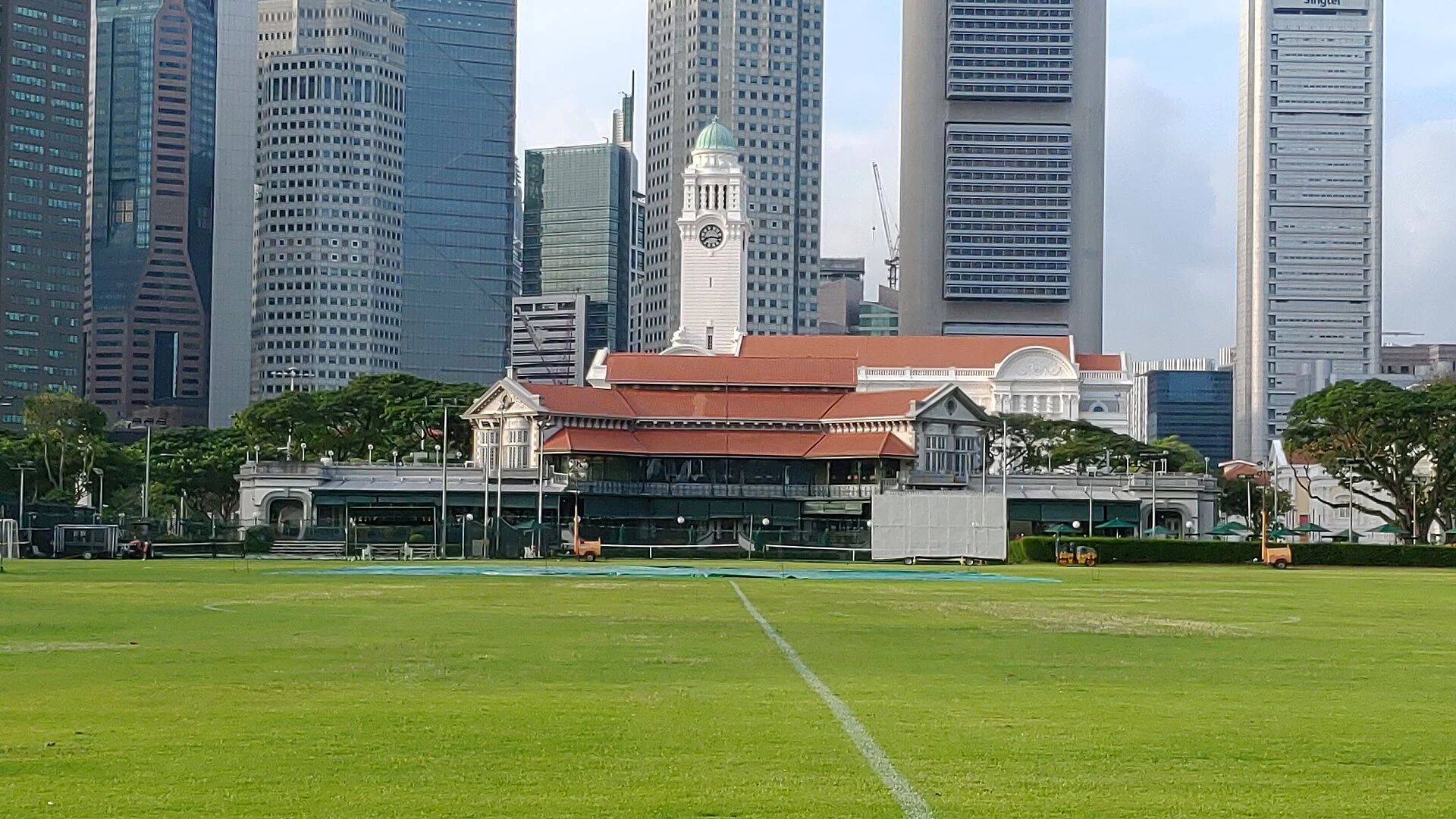
Across the water, the Singapore Cricket Club, register No. 075 has stood at the south end of the Padang since the nineteenth century. It was founded in 1852, and the core of its present clubhouse dates from 1884. It has more than 3,000 members, and its games are played in full view of the city: cricket, rugby, football and hockey on the Padang itself. Its reciprocal arrangements extend to clubs abroad, among them the Melbourne Cricket Club, which allows its members visits to Singapore of up to a month a year.
The Tanglin Club was established in 1865 and admitted only Europeans at its founding. It was used by the Japanese army during the occupation and reopened in September 1946, this time with twenty-three women members. In its early years it even lodged members of the German Teutonia Club while their own clubhouse was being built. Its current clubhouse on Stevens Road was built between 1977 and 1981, with a saltwater pool, tennis and squash courts, a library and six restaurants. Today it has around 4,000 principal members and reciprocal partnerships with more than 130 clubs.
What survives
The shape of these houses would be familiar to anyone from Pall Mall. What has changed is the membership. The founding restrictions on race and sex have gone, eased by committees and, where committees were slow, removed by law.
That leaves an interesting question for the next generation of members, which is what a colonial club is for once the colony has gone. The best answers so far have come from the clubs that leaned into the city around them: the correspondents with their bar, the China Club with its Shanghai, the Hong Kong Cricket Club with its pitch.
Sources
- Hong Kong Club, Wikipedia
- Hong Kong Club Building, Wikipedia
- How easy is it to join 5 Hong Kong private clubs that recall the city's colonial past?, South China Morning Post
- Foreign Correspondents' Club, Hong Kong, Wikipedia
- China Club, Wikipedia
- Singapore Cricket Club, Wikipedia
- Tanglin Club, Wikipedia
- Overseas clubs: reciprocal club rights, Melbourne Cricket Club