New York, from the Knickerbocker to Zero Bond
Two centuries of Manhattan clubs, most of them founded because somebody else said no.
- By
- The Index
- Published
- Length
- 4 minute read
- Filed from
- Manhattan, New York
London clubs were founded by men who agreed with one another. New York clubs, more often, were founded by men who had just been turned down. The city's club history reads less like a family tree than a series of walkouts, each one leaving behind a very good building.
The original grievance
The Union Club of the City of New York was founded in 1836 at a meeting in a private house on Bond Street. It is the oldest private club in the city, and the second oldest city club in the country after the Philadelphia Club. For its first decades it was simply the club, which is the kind of position that invites mutiny.
The first came in 1871. A group of Union members, among them Theodore Roosevelt Sr., decided the club had grown lax about whom it admitted, and left to found the Knickerbocker Club. The Knickerbocker has a reputation as one of the most aristocratic clubs in the country, and does nothing to correct it. Its neo-Georgian clubhouse at 2 East 62nd Street, by Delano & Aldrich, was finished in 1915.
The second walkout went the other way. In 1890 the Union declined two candidates, one of them John King, president of the Erie Railroad, whom J. P. Morgan had sponsored. Morgan's response was to found his own club. The Metropolitan Club was organised in 1891 with Morgan as its first president, and its clubhouse at Fifth Avenue and 60th Street, designed by Stanford White of McKim, Mead & White, opened on 1 March 1894. Early members were rich enough that the press called it the Millionaires' Club, though not every one of them was.
The Union itself moved uptown eventually. Its present clubhouse at Park Avenue and 69th Street, also by Delano & Aldrich, opened in 1933. The firm built the Knickerbocker, the Union and, as it happens, a women's club we will come to shortly. Manhattan's feuding clubs could at least agree on an architect.
The city's club history reads less like a family tree than a series of walkouts, each one leaving behind a very good building.
Artists, amateurs and graduates
Not every New York club began in a huff. The Century Association was founded in January 1847 by members of the Sketch Club, and is named for the first hundred people invited to join. It was meant for men of distinction in literature and the arts, and today admits men and women on the same footing. Its palazzo at 7 West 43rd Street was built by McKim, Mead & White between 1889 and 1891. The Century admitted women in 1988, after a city investigation into sex discrimination and a court fight over a new city law barring it.
The University Club of New York was chartered in 1865 for "the promotion of literature and art", and requires a university degree. Its clubhouse at Fifth Avenue and 54th Street, designed by Charles McKim, himself a member, opened in May 1899. It voted to admit women in 1987.
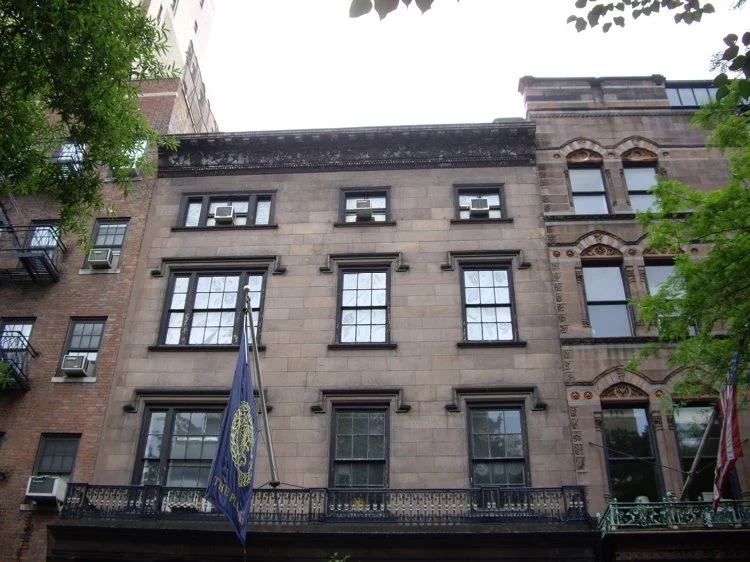
The Players, register No. 620 belongs to Edwin Booth, the Shakespearean actor, who founded it in 1888 in his house at 16 Gramercy Park South and had Stanford White remake it. It voted to admit women in 1987, and in 1989 Helen Hayes became its first woman member.
And the women's clubs
New York did not wait for the men's clubs to reform. The Colony Club, founded in 1903 by Florence Jaffray Harriman with Anne Morgan, J. P. Morgan's daughter, among its founders, describes itself as the first social club in the city established by and for women. Its first house on Madison Avenue was designed by Stanford White, with interiors by Elsie de Wolfe; its present clubhouse at Park Avenue and 62nd Street is by Delano & Aldrich again. The Cosmopolitan Club began in 1909 and has been at 122 East 66th Street since 1932. Willa Cather, Eleanor Roosevelt and Margaret Mead were members. There is more on both in our short history of women's clubs.
Downtown, a new grammar
For most of the twentieth century, being in a New York club meant being elected to an old one. The new clubs read differently. Zero Bond opened in NoHo in October 2020, six months late thanks to the pandemic, in an 1874 building that once housed a Brooks Brothers factory. Its founder, Scott Sartiano, has called it a London-style social club in New York; Will Makris is its managing partner. Fortune reported in 2021 that membership cost $3,000 a year with a $1,000 initiation fee, though prices of this kind rarely stand still. In March 2026 a second Zero Bond opened at Wynn Las Vegas.
It is not the only one. Soho House New York keeps a house in the Meatpacking District, and Casa Cipriani has turned a ferry terminal at the tip of Manhattan into a hotel with a club inside it, a model we look at in the rise of the hotel club.
What has not changed
The new clubs have phone booths, sushi bars and a membership team. The old ones have libraries, portraits and a committee. Both still ask the same question of every candidate, in slightly different words: who do you know here? In New York, the answer has always mattered. The good news, historically, is that a firm no has often been the beginning of a better club.
Sources
- Union Club of the City of New York, Wikipedia
- Knickerbocker Club, Wikipedia
- Metropolitan Club (New York City), Wikipedia
- Century Association, Wikipedia
- University Club of New York, Wikipedia
- The Players (New York City), Wikipedia
- Colony Club, Wikipedia
- Cosmopolitan Club (New York City), Wikipedia
- Inside Zero Bond, the New York social club where work and play are kept apart, Fortune
- Casa Cipriani, Wikipedia
- Zero Bond expands beyond New York with the opening of its private members club at Wynn Las Vegas, Resident